

In late 2025, Libby Jones left this mortal life after a long illness. She is survived by her husband of 50+ years Alex, three children, innumerable grandchildren, and hundreds of dear friends/adopted relatives. I have transcribed the biographical parts of her service below, they tell a tiny but invaluable fraction of her life’s story.
Speakers, in order:
- Sophie — Libby’s daughter (introduces the other speakers; mother of Nina)
- Sam — Libby’s son (lives in the US; wife Christina, sons Takeshi and Idris)
- Anthony — Libby’s son (wife Adriana; twins Fleur and Delphi)
- Nina — Libby’s granddaughter (Sophie’s daughter), who first reads a tribute written by Christina, Libby’s daughter-in-law and Sam’s wife, then gives her own
Other family referenced: Alex (Libby’s husband), Nick (eldest son, died 2018).
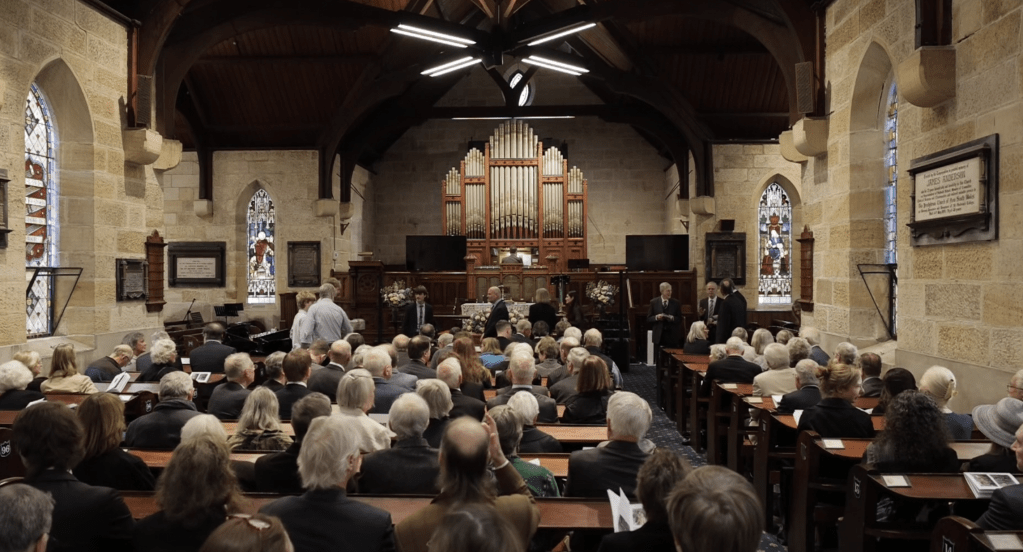
Sophie (daughter)
Firstly, I want to thank everyone who is here today and who is watching the live stream. Mum loved a big crowd, and the fact that so many people are here is a testament to how much she meant to everyone.
Libby was a unique person. She lived such a full life that to try to distill it is virtually impossible. I want to give you a brief outline of her life, which, if nothing else, will hopefully provide some context for the photos in the Order of Service. And Sam and Anthony and my daughter Nina will also share their memories and thoughts.
So to start at the beginning, Mum grew up in Bar Beach in Newcastle. She told us about a happy childhood going to the beach, playing tennis and spending summer holidays with her many cousins. She attended Newcastle Girls High School, and it won’t surprise anyone here to know that she loved Latin and debating at school and was a prefect and house captain. She remained a proud Novocastrian all her life. However, despite her loyalty to Newcastle, she knew there were broader horizons to explore.
So as soon as she finished school, she moved to Sydney to attend Sydney University, where she first enrolled in a Bachelor of Science and lived at Women’s College. At college, she became known as Libby. She started wearing her hair over one eye, was taught how to smoke by a more sophisticated fellow student, she met new people, went out a lot, and failed first year. The next year, she enrolled in a Bachelor of Arts, which is probably what she had wanted to do all along. Her extroverted and sociable nature meant that she knew literally everyone who was at Sydney University in the late 1950s, and she kept many of those friendships for her whole life.
Following university, Mum travelled to England and spent some time in Cambridge. She met new people, started to become involved in the folk music scene, had relationships, and even lived for a time on a Welsh island with no electricity. Returning to Sydney, she married a folk singer and moved to Melbourne, where she lived in a kind of hippie commune. While ideologically I think Libby agreed with the ideals of communal living, the reality left something to be desired. She was out working as a high school teacher, while the others were sitting around helping themselves to her own personal supply of Milo.
The marriage didn’t last long, but it did produce our dear eldest brother Nick. I’m sure it wasn’t easy to be a single mum in the 1960s, just as I’m sure it’s not easy at any time. But Mum had such an optimistic outlook and positive approach to life. She was not one for sitting around feeling sorry for herself.
Around that time, she became involved in the movement against the war in Vietnam. And of course, Libby being who she was, she didn’t just attend meetings. She was the regional coordinator of the Vietnam moratorium for the North Sydney area. She was never one to sit back. If any group or cause needed someone to be in charge, she put up her hand. And it was the Vietnam War that was the topic of my parents’ first conversation, or argument, when they first met at a party in November 1967.
My parents’ marriage was long and happy. They loved, supported and appreciated each other. We were lucky children indeed to be raised in that environment.
Although Mum loved entertaining and hosted innumerable dinner parties, morning teas, lunches and afternoon teas, she essentially had little interest in cooking or performing the role of stereotypical housewife. She liked entertaining because she loved people. Loved talking, discussing, laughing, celebrating life.
We spent two separate years in England when I was a child, and Mum of course made many more friends there. But what was special about Libby is that she kept many of those friendships for the rest of her life. She wrote Christmas cards, visited people, invited people to stay. And some of those friends are no doubt watching today. That was one of Libby’s talents. She didn’t let friendships fall by the wayside. She kept in touch with everyone.
She was a wonderful mother. She played with us, read to us, took us to Balmoral, and came to every single school event. She encouraged us, but she was all carrot, no stick. To be raised with that love and support was a great gift. Mum was incapable of tough love. Hers was the very softest love. I knew I could always ring her if I had forgotten my PE uniform, and she would sneak it up to school. And as an adult, if I ever needed help, she was the first person I would call. She never let me down. She never let anyone down.
During the 80s, Libby became involved in local politics, helping get Ted Mack elected, first to North Sydney Council, then as mayor, then state member, and finally federal member. Elections and politics was an enduring passion for Mum. She would letterbox, hand out how-to-votes, captain a local polling booth, scrutineer, and then roll on to the election party.
Although having a career was not a priority for Mum, she always worked. In early years, she was an English teacher, and later she worked in market research, as a bookkeeper, and for many years she was a secretary at Sydney Grammar. When Anthony started at Scots, she volunteered her time to edit school publications, and she later worked at Scots and Ascham in communications and publications. Her final job before she retired was at the Australian Catholic University in their communications team.
Mum and Dad threw themselves into coaching debating and public speaking, and Mum also threw herself into the New South Wales Classical Association, promoting the teaching of Latin and Ancient Greek in schools. She successfully lobbied for Latin and Greek to be retained in the New South Wales and Australian curriculum, encouraged the expansion of Latin teaching in more high schools, and assisted with running Latin and Greek reading competitions. Mum’s approach was: if anything could be achieved through hard work, she would achieve it.
There were many other groups and causes Mum was involved with over the years. The Women’s Electoral Lobby, the Council for the Defence of Government Schools, and the Movement for the Ordination of Women, to name just a few.
Religion was important to Libby. She attended St James in the city for many years, and later attended here at St Peter’s with Dad. Here she was the secretary of the church for more than a decade.
When grandchildren came along, she somehow fitted them into her busy schedule. She adored them and took them on all sorts of outings, as well as caring for them in the school holidays, helping with school pick-ups, and proudly attending school events.
About ten years ago, Mum started to have physical neurological symptoms, which gradually worsened. The death of our brother Nick in 2018 was a psychological blow I don’t think she ever recovered from, and the isolation of the COVID years also seemed to hasten her disease. A major fall at Christmas 2022 resulted in months in hospital and rehab, and after that she required daily in-home care. With the help of those carers, Dad was able to look after her at home until last December.
It was very hard to witness her increasing incapacity. The person who had always loved conversation was no longer capable of speech. The woman who had twice the energy of most of us was unable to walk, and by the end needed 24-hour care. But as hard as it was to witness, I have no doubt it was harder for Mum to experience.
However, today and tomorrow, I want to remember Libby as she was. Vibrant. Energetic. Generous. Warm. Loving. A bright light who cherished life and who made a difference to a great many people. A life well lived.
Sam (son)
All of us knew my wonderful mother in various of the roles that Sophie has described, and maybe, like me, you’re struck by how many different roles there were and how much energy my mum had for so many distinct, apparently full-time passions over her life. And I’m even struck by contradictions. The public school teacher and defender of government schools, and the booster of Scots. Opponent of Western imperialism, and attendee of the Dawn Service. Free spirit of l’anarchie, and the holder of the Order of Australia.
But my darling mother was protean in her character. And this wasn’t because she was a chameleon, but because she embraced the possibilities for being that she found in different situations. I think that all her life, her nature was a permeable one rather than self-sufficient. She was sentimental and sympathetic, passionate and restless and needy and intelligent.
And of course, this wasn’t always easy for her. Early in her adulthood, she was taken advantage of by a series of men who used her and abused her emotionally and even treated her with physical violence, which was horrible to think about. I won’t name names, of course — but John, if you’re listening, you’re not one of those. [laughter] I judge that her loving relationships with Nick, my brother, and my father were stabilising forces. And thank you, Dad. But in any case, Mum’s gaining control of her own self-creation as an adult was a triumph. The free spirit of l’anarchie came into her own.
Of course, it’s easy to say that she found connecting threads in her life. She loved literature and Latin and the beach. She loved taking on the challenge and making it a success. Her family, children, friends — and she loved my wonderful father.
And so many of my own memories of Mum have shared themes of fun and love. I think of the carefree young mother at Balmoral cutting a picnic cake with the arm of her sunglasses because she forgot to bring a knife. Our mother, the lover of West Dorset, sharing our joy in sledding on the icy roads of West Milton. And she loved that world so much, with its gentleness, its tea shops and its labour history. I think of the fun but conscientious caregiver to children at Wyong. She would sit for hours on the wharf to keep an eye on us and our cousins swimming in the river while she caught up on belated Christmas correspondence.
One autumn, Mum visited us in America and sat on our sofa for hours listening to Takeshi, my son, practising his readers, and loving it, and delighting in Idris and playing. Certainly as children, we never felt that there was any place that she would rather be than with us.
I also have images of sadness that I can’t forget. Memories that are mine because Mum shared them with me. Of my beautiful mummy in a 1960s mental hospital in England, or waiting with our brother Nick’s dead body for the ambulance to arrive — alone with him at the end, as at the beginning of his life.
Some of my most important memories of my mother are of her being enraged by wrongs and wanting to do something. She would furiously confront a belligerent adult who was beating a child in the street. We were of course brought up on stories about activism against the war in Vietnam — her vivid descriptions of leafleting in town in the late 60s, when the Labour Party had abandoned the anti-war movement, a brave single mother with little Nick in tow being threatened and screamed at by men in suits.
In one of the last real conversations I had with Mum, while she was still able to communicate a bit, she asked me with great difficulty if I’d been to a rally for Palestine that day. And I said no, it was a Wednesday, and so there weren’t any protests. Mum looked at me sternly and said, with difficulty: you should protest for Gaza every day.
Anthony (son)
It might superficially appear that my mother was a confusing mix of traits. She was the extroverted and sociable host who, as you’ve heard, had no interest in trifles like being able to cook or having any discriminating taste in food or wine. She was an extremely busy and capable engine of so many institutions and communities, but without any interest in being organised, neat or tidy herself. She was entirely respectable and outwardly conservative, but with absolutely no respect or deference to authority, the forces of conservatism, or indeed the police. She was fiercely loyal and intensely competitive on behalf of those to whom she had a tie of allegiance, and yet she adopted people and causes into her orbit with abandon and almost without discrimination.
I don’t see any of this as a contradiction. I think what it was is that my mother was entirely committed to the things that are important, and completely indifferent to what is not important.
That is not to say that she was always rational. About 15 years ago, just before a large party at Wyong for 30 or so people, my mother wasn’t feeling well. Something was up. It was one of those languid, scorching late summer days where the tomato sauce in the glass bottles is almost boiling. But the show had to go on, and my mother assumed her party face and had a wonderful day — as, of course, did everybody else. The next night she was taken to hospital and told that her appendix had already burst. But what are the accumulated toxins of a lifetime against the powerful tonic of 30 happy faces, good company and good humour?
She gave the best of herself to others, and always assumed the best of others too. One suspects bending their will and breaking their cynicism with her special brazen charm. I remember once on the way to school the car broke down in the middle of the Harbour Bridge. Mum got out, flagged down a passing vehicle, and told the driver to take me and my cello to Bellevue Hill so I wouldn’t be late. I asked her later how she could be confident that I wouldn’t be abducted and murdered. She said that someone with a King’s School sticker in the window of the car wouldn’t do that sort of thing. Which, thankfully as it turned out, was 100% correct.
We were all so lucky to have her. To be swept up in and moulded by her unselfconscious commitment to the important things. To charity and generosity and optimism and ambition and hope. I and my wife Adriana and our children will miss her terribly.
Adriana and I well remember the generosity of Mum’s welcome when she first met Adriana, and the great excitement she always had in meeting and hearing news of our children. When our twins Fleur and Delphi were to be born this year, we hoped they would have some chance to experience Libby’s life — her love and characteristic enthusiasm. Sadly, that wasn’t possible in this life. But it gives us great comfort to know that Libby has probably already welcomed our daughter Delphi in heaven, just as she will be so excited to welcome us all one day. Free forever of what is unimportant, and illuminated forever by the glow of what matters.
Nina (granddaughter)
Hi everyone. I’m Nina, and I was lucky enough to be Libby’s granddaughter. I’ll begin by reading my Auntie Christina’s words. Christina is Libby’s daughter-in-law and Sam’s wife, and sadly can’t be with us in person today as she is in the US.
Christina’s tribute (read by Nina)
I first met Libby in 1995, when Sam and I started going out. Libby and Alex were incredibly welcoming to me and my entire family. I remember early on a trip to the family holiday house at Wyong during the summer holidays. My sister and I were put up in the brass bedroom — the best bedroom at Wyong, in my opinion — with two old-fashioned brass beds. I’m sure it was Libby’s decision to put us in there, to show off Wyong to best advantage. And it worked. We couldn’t believe our luck. We felt as though we could realise our childhood fantasies of living in the 19th century and of being part of the Famous Five that summer at Wyong.
But this wasn’t just fantasy, as the charming house on the Wyong River was deeply meaningful to Libby and the rest of the Jones family. It has been the site of happy memories for generations of the family, and the house was filled with their books, photographs and other treasures. Libby loved explaining what all these treasures were and how they connected to the family, present and past. As well as serving as sort of a charming museum for the family’s history, the house was also still very much a living part of Jones family life, with countless meals on the front veranda with extended family and friends.
Many of you here today will have visited Wyong and attended social occasions there, many of them organised and hosted by Libby. At these meals, people connected across generations. Libby used these occasions to facilitate one of her favourite beliefs — that everyone links up — by connecting us all to each other. I was always impressed with the way that Libby managed to speak to every single person at these events, no matter how large the crowd, and showed a deep and sincere interest in us all.
For my sister and me, that first visit to Wyong was an introduction to the Jones family, past and present, and it was an experience filled with warmth, laughter and love, especially thanks to Libby. It was the first of many occasions, not only at Wyong but also at Kirribilli and elsewhere, where Libby welcomed me into her family, as so many of us have experienced. Libby loved people and their histories, and she loved bringing people into her family’s life.
As time went by and I came to know Libby better, I grew not only to love her but also to admire her immensely. Her generosity and kindness knew no bounds. She was someone who gave tirelessly to so many people and to so many causes. I came to realise that Libby did this not because giving was so very easy for her, but because she felt compelled to give and to be kind. Not that it was a duty or an obligation for her, but because she was driven by a desire to be kind. Libby’s Christian faith was an important part of her life, and Libby embodied the life of a true Christian. She was a person who gave every ounce of her body and soul to be kind and generous, and we have all benefited enormously from this.
A huge part of Libby’s life was her marriage to Alex. They were a model couple, always so loving and attentive to one another, as well as obviously delighting in each other’s company. Libby was absolutely devoted to Alex, and vice versa. Every time Alex wrote a book, while Libby was well enough, there was a book launch. These were occasions to bring people together and also to celebrate Alex’s achievements, of which Libby was immensely proud. Libby obviously adored Alex and admired his intellect, but although she always claimed a modest intellect, she was as sharp as a tack and a match for Alex. At the dinner table and over many cups of tea, they discussed ideas of all sorts, from politics to poetry.
In recent years, when illness began to take its toll, Alex stepped up to look after Libby, and Sophie too has played a crucial role in caring for both her parents. Alex took on the role of primary carer without complaint and with loving kindness, utterly devoted to his partner, until it became too dangerous to keep her at home any longer. The love and devotion that Libby and Alex embodied in their marriage is a model for us all. I am so fortunate to have known Libby and to have had her as my mother-in-law.
Nina’s own words
Thank you for listening to my auntie’s words. I’d like to follow by sharing some of my own memories.
As most of you would probably know, Libby loved talking about how proud she was of her loved ones. So now it’s my turn to tell everyone how proud I am of my grandma.
For as long as I can remember, I have always had grandma days with my active and deeply involved grandma. My childhood with her was filled with adventures. We went to museums, to beaches, to the Opera House, to have lunch with Grandpa at uni. We were always getting taxis and hurrying off on errands together all across the city.
I’m sure I speak for all her children and grandchildren in saying that anything I showed interest in, she would enthusiastically support. She took me to piano lessons every week. She recorded school performances in secret, ensuring she burnt about 20 copies onto CDs to be distributed to family members. She even acted as a self-appointed and much-loved debating coach, creating folders filled with pre-rebuttals and newspaper cutouts to hand out to my team each week. She came to every one of our debates. If we won, it was a great triumph, and if we lost, she would always assure us that we had been robbed.
She instilled in me the value of hard work and nurtured confidence. I remember one occasion when I was about five or six, when I really wanted to learn how to fly. Grandma and I made wings out of cardboard and glued leaves and flowers from the garden onto them. We then spent all day together trying to teach ourselves how to fly.
Grandma’s endless care and devotion to me is something that I will dearly miss. She always made me feel encouraged, special and loved.
Libby lived a joyful, bustling and somewhat mysterious life, forever dashing between events, committee meetings and parties. We never knew quite where she was bound, only that she’d leave her lipstick-blotted post-it notes behind her like a trail of breadcrumbs. As I remember my grandma’s youthful exuberance — a quality which she carried with her throughout her life — I am constantly inspired to fill each day with optimism, liveliness, and adventure. I think her boundless energy and love for life can be characterised by the line she always used to say to Grandpa: “Aren’t we lucky young people?”
I never want to forget how to live like Libby, so I’ll end with some of the most important lessons I’ve learnt from her. The first lesson is to fill your life with commitments and activities, and never say no to an invitation. This leads me on to my second lesson. As Libby was a busy lady with a plate full of commitments, she didn’t have any time to waste trying to find parking. She showed me that anywhere is a parking space if you have enough confidence. Just drive up to where you want to go and park right outside.
She taught me to never say I was bored, to always stand up and protest for what I believe in, and to always keep in touch with everyone, even if it was just to send a Christmas card once a year. She never let perceptions of age get in the way of her doing anything, and for all of my life at least, she never told anyone how old she actually was. She taught me the value in throwing big parties, hiring big venues and inviting everyone. She loved endlessly, called everyone darling, and always thought the best of everyone.
And finally, she taught us that this life is wonderful — live it vibrantly and passionately.
Transcribed from elizabeth_jones_v2.mp4, approximately 43:54 – 1:09:30. Transcription: Whisper large-v3 (local).

